I recently represented a cyclist who was the victim of a hit and run accident that broke almost every bone in his body and caused traumatic brain injuries. The driver of the car turned out to be a 19-year-old woman who was driving drunk. She claimed not to have known that she hit my client, in spite of his leaving nine teeth in her SUV’s back seat.
My client’s medical bills were astronomical and because of the brain injuries, his life would never be same. The compensation my client received from this case would be his primary source of income for the rest of his life. The woman’s insurance company wanted to settle the claim for “policy limits,” which is the maximum amount they are required to compensate a victim of serious personal injuries or even a wrongful death.
Policy limits is how much insurance you bought in a specific category. In California, you are required to carry car insurance of $15,000 per person for bodily injury liability; $30,000 per accident, which covers all persons hurt in one accident; and $5,000 for property damage liability for one accident. It is likely that your insurance policy includes a minimal amount of uninsured and under-insured auto insurance, but rarely is it a significant amount.
If you suffer catastrophic personal injuries or a family member is lost in a wrongful death due to a motor vehicle accident (car, bicycle, motorcycle, truck, bus, boat), your damages (medical and economic) could cost hundreds of thousands – or even millions – of dollars.
The person who was negligent is responsible for your damages. (In some cases, negligence may include one or more companies or a public entity like the state or a county, but for the purposes of this article we are focusing on individual drivers.) Their insurance company will cover those damages only to the limits of the individual’s insurance policy.
If the person who caused your accident owns a house or other property, you may be able to recover some monies from them after a long and expensive court process. You might even be able to garnish any money they earn or receive in the future.
But many drivers own nothing – or not enough – to ever come close to compensating you for your injuries or for your lost loved one. You will be on your own to pay your medical and therapy bills, to subsidize your living expenses either for the short or long-term, to pay childcare expenses, and to replace your destroyed property.
The best way to protect yourself from this disaster is to carry as much uninsured and under-insured auto insurance as your insurance company will permit you to buy. The cost is pennies on the dollar. The more you have to lose (meaning the more you own or could own in the future), the more uninsured and under-insured auto insurance you should have.
Uninsured and under-insured auto insurance protects you when you are hit by a driver who has no insurance (and a Los Angeles County sheriff told me recently that in approximately 50 percent of all motor vehicle accidents he sees the driver is uninsured). It also kicks in when you reach the maximum the OTHER driver’s insurance will pay. It compensates you for the difference between what the other driver’s policy limit is and the actual compensation you need to recoup from the damages caused by the accident.
Uninsured and under-insured auto insurance also protects you if you suffer serious personal injuries (or worse) in a hit-and-run accident. With the frightening rise in hit-and-runs, it is critical that you protect yourself.
In my client’s case, I was able to negotiate additional monies from the woman’s family. Though I was able to recover a multi-million dollar settlement for this client, it is still nowhere near what he should have received considering the damages she inflicted on him and for which he will have to live with for the rest of his life.
My hope for you is that you never need to use your uninsured and under-insured auto insurance, but I urge you strongly to get as much uninsured and under-insurance auto coverage that your insurance company will allow you to purchase, before you need it.
*California Vehicle Code 21200: A person riding a bicycle or operating a pedicab upon a highway has all the rights and is subject to all the provisions applicable to the driver of a vehicle. . .
For more than 25 years, Jim Pocrass has represented people who were seriously injured, or families who lost a loved one in a wrongful death, due to the carelessness or negligence of another. Jim is repeatedly named to Best Lawyers of America and to Southern California Super Lawyers for the outstanding results he consistently achieves for his clients. Having represented hundreds of cyclists during his career, and Jim’s own interest in cycling, have resulted in him becoming a bicycle advocate. He is a board member of the Los Angeles County Bicycle Coalition. For a free, no-obligation consultation, contact Jim Pocrass at 310.550.9050 or at info@pocrass.com.*
Last Sunday we attended the Los Angeles Bicycle Commuter Festival & Summit, which was organized by the Bicycle Culture Institute and its L.A. Bike Trains program. After helping to set up the Pocrass & De Los Reyes booth, I wandered around saying “hello” to old friends and making new ones.
As I was thinking about the many conversations I had with a variety of people at the festival, I was struck by the two things they all seemed to have in common: 1.) they all ride bikes and 2.) every one of them told me they’d been in a bicycle accident at some time in their life.
You wouldn’t think this would be such a revelation to me. After all, as a recreational cyclist, I, too, have been yelled at, “flipped off,” and only avoided a collision (so far), because I was more aware than the motorist was.
As a bike accident lawyer, I have handled hundreds of bike accident cases, which has allowed me to develop a relationship to many people who have suffered life-altering injuries, because of the negligence or carelessness of another. I see their struggle to heal: physically, emotionally and financially. As one of the exhibitors, whose accident left him with numerous pins in his leg and with a limp, said to me Sunday, “You heal, but you’re never the same.”
It’s a peculiarity of human nature that when we meet someone and they tell us their career, we have an urge to tell them our personal experience with their profession. We tell doctors our symptoms. We tell IT people our computer problems. And we tell bike accident lawyers about our bike accident case.
I never mind when people want to tell me about their bike accident case, even if it was resolved years ago. I am, though, very careful of how I respond. After all, I am hearing someone’s perspective, and I haven’t reviewed the case. I don’t want to Monday-morning-quarterback another lawyer.
There have been a few times (one of which happened last Sunday, which was the genesis of this post), that inside I was just shaking my head trying to figure out what the person’s lawyer was thinking. But I’m not going to go into that here.
Instead, I am going to give you the secret code of how to choose a lawyer. And though this information generalizes to all practice areas, I am going to use bike accident lawyers as an example.
Bike Accident Experience: does the lawyer have experience in handling bike accident cases? Just as you wouldn’t go to a foot doctor for a heart condition, you don’t want to go to a business attorney for a bike accident.
A bike accident attorney is very familiar with bike accident and motor vehicle law. These laws can be complicated, especially if a bicyclist is hit by a truck and then all sorts of federal or state laws could apply.
Another example is California’s comparative negligence law. This means that the court (or jury) can apply percentages of fault in a motor vehicle accident and a bicycle accident. So even if the cyclist is found to be 10 percent at fault, other entities could be found to be 90 percent at fault, and compensation is proportioned out on that basis.
This is particularly important in terms of liability. If you are hit by a car and the motorist’s policy limit is, for instance, $50,000, then that is all the compensation you could get regardless of the verdict or the settlement.
An experienced bicycle accident attorney knows how to determine if someone else could be partially responsible for the bike accident, in addition to the motorist. Maybe it is a dangerous road or signage is poor and that particular spot has a history of accidents. In those situations, a government entity may be brought into the case.
Verdicts and Settlements: check the attorney’s record of verdicts and settlements in bike accident cases. There are attorneys who have little or no trial experience and automatically settle with insurance companies. This will work to your detriment.
The insurance companies know which lawyers do not want to go – for whatever reason – to court.Lawyers who are known to avoid court give the insurance company license to low ball their offers, which means you may not get the full amount of compensation you deserve and which you may need desperately.
Resources: checking the attorney’s record of verdicts also tells you their experience at trial. Court trials are very difficult. Contrary to popular belief, juries do not automatically lean towards the plaintiff, which is, typically, you. In fact, because of the insurance companies’ decades-long public relations campaign of “jackpot justice,” juries are often prejudiced against people who bring lawsuits.
What evidence is admissible and allowed into “the record,” takes years of learning and skill. Trust me; it is nothing like what you see on television. Trials are a game of rules, and the outcome is often dependent on how well an attorney knows those rules.
But maybe most important for you to know is that going to court takes thousands and thousands – sometimes even more than a million – dollars. Medical experts (doctors) charge between $500 to $1,000 a day. Just filing a complaint with the court is almost $500. All of this money is typically paid for by your bicycle accident lawyer until the case is resolved.
If an attorney does not have the financial resources to fund your case, they may not take your case to trial. Especially in today’s economic climate, insurance companies are refusing to settle (hoping you will go away) or low-balling offers. It is critical that every case be prepared as if it is going to trial.
Today it is not unusual for the insurance company to “settle on the courthouse steps” or while the jury is deliberating. But I can guarantee, if the case was not taken to trial, the cyclist would get nothing or little in settlement in those types of cases.
Affinity with your Lawyer. It is very important that you are comfortable with your bike accident lawyer and with their staff. You will develop a very close relationship with all of these people. You want to make sure that they are there to respond to you in a reasonable amount of time, that they understand your particular needs, and that they explain the legal process in ways you can understand so that you can make informed legal decisions.
I am a great believer in the American justice system. Like most trial lawyers, I have seen justice prevail many more times than I have seen it fail. Yes, it could be improved (better funding for the court system would be the first place to start), but I believe in it. However, the one thing I know absolutely is that the lawyer you choose – for all your legal issues – can make or break your case.
*California Vehicle Code 21200: A person riding a bicycle or operating a pedicab upon a highway has all the rights and is subject to all the provisions applicable to the driver of a vehicle. . .
………
For more than 25 years, Jim Pocrass has represented people who were seriously injured, or families who lost a loved one in a wrongful death, due to the carelessness or negligence of another. Jim is repeatedly named to Best Lawyers of America and to Southern California Super Lawyers for the outstanding results he consistently achieves for his clients. Having represented hundreds of cyclists during his career, and Jim’s own interest in cycling, have resulted in him becoming a bicycle advocate. He is a board member of the Los Angeles County Bicycle Coalition. For a free, no-obligation consultation, contact Jim Pocrass at 310.550.9050 or at info@pocrass.com.
Someone in my office came to me recently to tell me that as she was driving home she saw a bike accident. The car that had hit, presumably, the cyclist was parked nearby. There were a few people helping the cyclist, who sat in the middle of the road. She could hear the sirens of emergency vehicles that were on their way.
She said that though she wanted to stop to help, she felt that since there were people at the scene already, it wouldn’t be useful. So she didn’t stop. She asked me if I thought she should’ve stopped.
Upon thinking about the question, I told her I thought she should have. Because we work with so many cyclists who have been in bike accidents, we know what information the cyclist needs if they want to pursue a legal case.
In the immediate aftermath of a bike accident, even the most knowledgeable cyclist is probably shaken and stunned. If the cyclist has suffered serious personal injuries, they may be incapable of collecting the necessary information.
Also, there is no guarantee that the people who stop really know what information the cyclist – or the cyclist’s family – is going to need for legal action. More than likely, the people assisting the fallen cyclist are most concerned, understandably and rightfully, with the cyclist’s injuries.
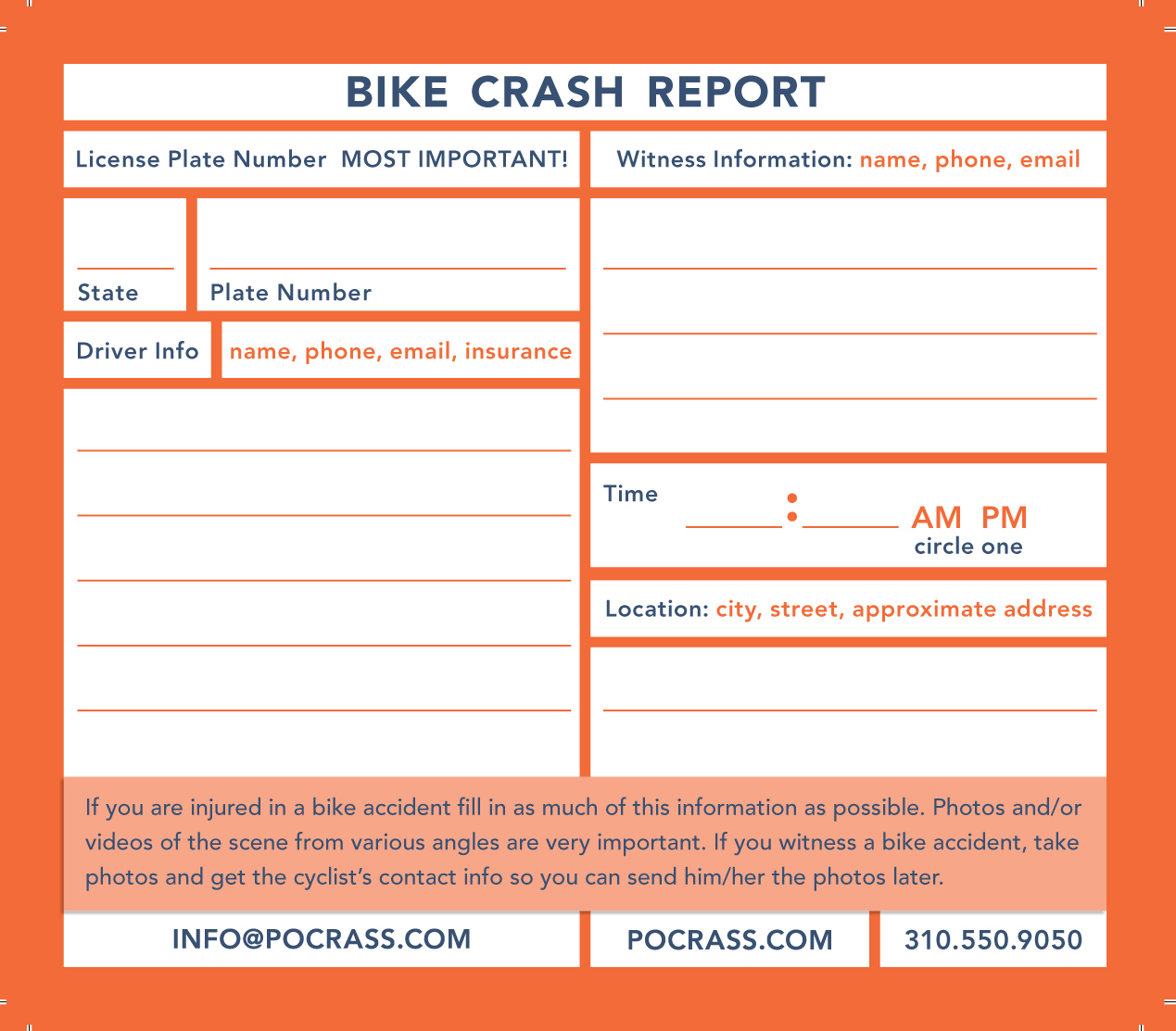
If you see a cyclist down, of course the first thing to do is to call the police and to get the cyclist emergency medical assistance. If that is being done by others, you can best assist the fallen cyclist by writing down the following information:
Time & Place: Notate the time the accident happened as well as the location. You want to include approximate address, the nearest cross street(s), and the city.
Vehicle Information: Most importantly, get the license plate number and state. Note: if the cyclist was hit by a truck, you need to get the license plate number of both the cab and the trailer. They may be different. Write down the make, model, year, and color of the vehicle that hit the cyclist.
Driver Info: Get the driver’s name, phone, address, email, and driver’s license number (and state). Get the driver’s insurance information, including company and policy number.
Witness Info: Get the name, address, phone, and email of any witnesses (including any passengers in the vehicle).
Photos: One of the most helpful things you could do for the cyclist is to take pictures with your phone. You want pictures of the bicycle and of the car (multiple views and as close as possible). Then take multiple pictures of the scene of the accident, from numerous angles, as it relates to street signs, lights, corners, and curbs.
Once you have collected this information, write down your contact information, with a brief note that you have witness information and photos, and give it to the fallen cyclist, tuck it into the cyclist’s pocket, or give it to a paramedic to put with the cyclist’s possessions.
The worse the cyclist’s injuries are, the more important this information will be to the cyclist or to the cyclist’s family.
You don’t need our help to do this, but we did create a free, wallet-sized guide to carry with you should you have a collision or should you see a fallen cyclist. You can either download a version of it here, or send us an email and include your mailing address and we’ll mail you a hard copy of the guide.
A very experienced cyclist, whose case we are handling, told us that he had one of our guides in his wallet when he had his bike accident, and he was so shaken he never thought about using it.
So let’s help each other and gather the information necessary to strengthen each fallen cyclist’s legal case. If people will not be careful around cyclists because it’s the right and legal thing to do, maybe they will change their behavior when they feel the sting from their pocketbooks.
*California Vehicle Code 21200: A person riding a bicycle or operating a pedicab upon a highway has all the rights and is subject to all the provisions applicable to the driver of a vehicle. . .……….
For more than 25 years, Jim Pocrass has represented people who were seriously injured, or families who lost a loved one in a wrongful death, due to the carelessness or negligence of another. Jim is repeatedly named to Best Lawyers of America and to Southern California Super Lawyers for the outstanding results he consistently achieves for his clients. Having represented hundreds of cyclists during his career, and Jim’s own interest in cycling, have resulted in him becoming a bicycle advocate. He is a board member of the Los Angeles County Bicycle Coalition. For a free, no-obligation consultation, contact Jim Pocrass at 310.550.9050 or at info@pocrass.com.
After talking bike law with him on several occasions, I can assure you he knows his stuff. In fact, the column below matches my own experience, when a bad police report resulted in the insurance company rejecting my claim when I was injured by a road raging driver.
So I hope you’ll join me in welcoming Jim to BikinginLA. And take his advice to heart — if it could happen to me, it could happen to anyone.
………
Jim Pocrass, Pocrass & De Los Reyes LLPBy James L. Pocrass, Esq.
I recently took a Malibu bike accident case in which the driver of a motor vehicle made a left turn into the cyclist. The accident happened at dusk; it was not dark out yet. The police report states that the cyclist was cited for “unsafe speed conditions” because he was wearing all black.
Police blaming the cyclist for the accident is not unusual. I don’t think I have ever had a bike accident case – and I have represented hundreds of cyclists – in which the police report did not blame the bicyclist. Nevertheless, it is important that you file a police report if you are in a bike accident.
Though police officers are often biased against cyclists, they usually get the facts of an accident correct. Such details of the accident: the time, place, weather, what direction each participant was going and where they were located when the accident happened, contact information for witnesses, confirmation of insurance, and any physical evidence at the scene, is usually recorded correctly.
It is the police officer’s conclusion that is typically wrong. Though I would much rather police officers would lose their cyclist bias, filing a police report is still beneficial to your legal case and to your insurance claim because it sets out in writing the basic facts.
Police reports with tainted conclusions may make the handling of your case or insurance claim more difficult, but the police report and the opinions and conclusions of the police officer are not admissible in court. They are all considered hearsay.
The problem comes in when the insurance company reads the police report and accepts the officer’s conclusions. They may refuse to settle your case or offer you much less compensation than which you are entitled. The result is that we have to file a lawsuit, gather evidence, and take the police officer’s deposition to prove the officer was wrong. Frequently it is during or after the deposition stage that the insurance company will offer to settle the case to avoid going to court.
So if you are in a bike collision, file a police report. In quite a few cities – including the City of Los Angeles – if you say you are not injured (and you should NEVER comment on injuries or guilt), a police officer will not come to the scene. In that situation, you need to go to the police station at your earliest opportunity (even sooner than that), and file a police report. Get the facts on the record.
Remember, filing a police report does not mean you have to file a legal case. It can assist you in collecting compensation for damages you incurred in the bike collision and, should you decide to take legal action later, it will be an important tool to give your bike accident lawyer as he is pursuing your case.
*California Vehicle Code 21200: A person riding a bicycle or operating a pedicab upon a highway has all the rights and is subject to all the provisions applicable to the driver of a vehicle. . .
………
For more than 25 years, Jim Pocrass has represented people who were seriously injured, or families who lost a loved one in a wrongful death, due to the carelessness or negligence of another. Jim is repeatedly named to Best Lawyers in America and to Southern California Super Lawyers lists for the outstanding results he consistently achieves for his clients. Having represented hundreds of cyclists during his career, and Jim’s own interest in cycling, have resulted in him becoming a bicycle advocate. He is a board member of the Los Angeles County Bicycle Coalition. For a free, no-obligation consultation, contact Jim Pocrass at 310.550.9050 or at info@pocrass.com.
Last night, I tried to have a rational discussion with someone on Twitter/X who disagreed with me.
And was quickly reminded why that’s a bad idea.
Admittedly, I eventually lost my cool. Well, only if you consider telling someone to “eat shit” before blocking them losing your cool.
I don’t take kindly to someone trying to tell me who and what I am, and what I believe, without knowing anything about me other than some point the disagree with.
Or maybe they just find my whole existence disagreeable.
But the gist of the conversation, with someone who described himself as an active bicyclist, was A) Los Angeles isn’t Amsterdam, B) bike lanes allegedly slow traffic and hurt business, and C) this has always been a car-centric city and always will be.
Which is fine. He’s entitled to his opinion, just as I am to mine.
And he’s right, Los Angeles isn’t Amsterdam. Neither is Paris or Copenhagen. Only Amsterdam is Amsterdam, just like only LA is LA.
But that doesn’t mean a city can’t change.
Amsterdam wasn’t always what it is today. In the 60s, it was a car choked, traffic clogged mess, until people got tired of the endless toll of traffic deaths, and began the “Stop de Kindermoord” movement.
That is, stop murdering children with motor vehicles.
That was the beginning of a total reimagining of the city that made it one of the most walkable, bikeable cities in the world today, where driving is usually the last choice when other options aren’t practical.
The same is true with Copenhagen, at roughly the same time and for the same reasons.
Yet despite the assumptions of those who so casually throw out “this isn’t Amsterdam” as if it’s a trump card, those cities are far from unique. In just the last decade, we’ve seen Paris reinvent itself to be far more walkable and bikeable, utilizing the concept of the 15 Minute City.
And in just the last few years, we’ve seen London transform to the point that bikes often outnumber cars in the city center.
Even my Colorado hometown took a similar journey.
When I was a kid, there were no bike lanes. The first bike path, along the river through town, was built while I was away.
But as the city grew from 10,000 people when I was in grade school, to 25,000 in high school, to nearly 170,000 people today, it continued to sprawl and be built around cars, with the inevitable traffic and congestion, until the people there said “enough.”
Today it is a Platinum Level Bicycle Friendly Community, according to the League of American Bicyclists.
In other words, it changed, because the people who live there wanted it to. Boulder, about 45 minutes to the south, took a similar path.
Maybe those cities are outliers. Or maybe the only reason Los Angeles, and other similar cities, aren’t like that is that the people haven’t demanded it.
Yet.
His second argument was based on a basic fallacy.
He made the case that bike lanes that were installed, then removed, in Playa del Rey because they slowed traffic, and there weren’t enough bike riders to justify them.
Which was kind of the point.
They weren’t installed for our benefit. Making the city more bikeable and a little safer was only an added bonus, brief though it may have been.
They were installed as a tool to calm traffic, intended to slow cars and reduce traffic flow because of the unacceptable level of traffic collisions and deaths in the Playa community.
And while it’s possible that they may have initially hurt local businesses, repeated studies have shown that retail sales and tax receipts usually increase within a year or two after the installation of bike lanes — and the people who initially fought the lanes often later fight to keep them.
That didn’t happen in Playa, simply because they were never given the chance.
The final argument is also based on a fallacy.
Anyone who lived here in the ’30s or ’40s wouldn’t recognize the car-centric city we have devolved into. Los Angeles once had the best transit system in the country, with every neighborhood efficiently served by the Red and Yellow Cars.
Those were the trolley systems that once ran down the middle of every major roadway. But they were removed to make way for cars, resulting in the overly wide boulevards we have today.
Before that, the city’s roads were built and paved to accommodate bicycles, prior to the mass production of motor vehicles.
And before that, it was a city of dusty roads and trails for horses and wagons.
So the city has already reinvented how it gets around multiple times. And we can do it again if a majority of Angelenos want it.
Then again, the two-third majority who voted for Measure HLA would seem to suggest they do.
I won’t get into the whole thing now — or probably ever — except to say that it, too, is based on a couple of basic fallacies, which like a butterfly flapping its wings on the other side of the world, sends the whole damn thing off in the wrong direction.
The concept of traffic violence was never intended to suggest that there is anything intentional about it. Simply put, traffic violence reflects the fact that crashes are violent events, which can inflict violent trauma to its victims.
And like other forms of violence, the causes can be addressed, and the effects minimized.
As for the idea that traffic violence, or traffic deaths, are an epidemic, that isn’t meant to suggest it has suddenly become so. Violent crashes and traffic deaths have been epidemic ever since the motor vehicle was invented.
Traffic deaths have always been too high. Calling them an epidemic now is merely a recognition of the problem.
It’s kind of like if measles had always been around, and no one ever bothered to do anything about it. Then one day, someone pointed a finger and called the problem an epidemic that could be treated.
One last point.
The writer of this piece suggests that the solution to safer streets isn’t separating bikes and pedestrians from motor vehicles, but for everyone to focus on sharing the road safely and efficiently.
I used to believe that, too.
I have often said that if everyone obeys the law, and share the road in a safe manner, that crashes are unlikely, if not impossible.
But that fails to account for human nature.
People will inevitably make mistakes, and do whatever is most convenient for them in the moment, largely because they’ve always gotten away with it before. And will continue to get away with it, until they don’t.
Which is the whole rationale for Vision Zero, based on the idea that human beings make mistakes, and roads should be designed so those human mistakes don’t become tragedies.
If you disagree with that, that’s fine. We should be able to disagree without being disagreeable, and find a consensus that works for the majority of people, while protecting the rights of the minority.
That’s how democracy works.
So disagree, vehemently if you must.
But try to keep the insults to a minimum. And I will, too.
Photo by Joni Yung.
………
Megan forwards the Meyer’s Brothers podcast, in which Danish actor, producer and screenwriter — and the Game of Thrones Jaime Lannister — Nikolaj Coster-Waldau reveals not only that he’s one of us, but that bicycling is his favorite form of transportation.
Hawaii is joining the long list of states cracking down on ebikes, with one resident telling lawmakers it’s become a Wild West,” with little kids “zipping out around a corner on the sidewalk with some high-speed motorized vehicle.”
In a doubly tragic case of Texas symmetry, two 16-year old bicyclists were struck by drivers while each was riding with a companion; one suffered life-threatening injuries, while the other sadly didn’t make it. In the second case, both rides were struck by the driver, while in the other, the victim was hit so hard his GPS showed him flying off his bike at nearly 78 mph after the impact.
In yet another example of keeping a dangerous driver on the road until it’s too late, a 37-year old Louisiana man faces a number of charges after critically injuring a 63-year old bike rider who had stopped to fix his chain — including his 4th DUI. In any rational world, he would have been off the road after his second. If not the first.
CBS LA offered a brief report one of the Los Angeles rides, taking with Finish the Ride founder Damian Kevitt across from the VA grounds about how Alex Pretti was one of us, as Pretti’s parents said he would have loved the rides.
The LA Timesalso covered the same ride, one of several held in the Los Angeles area, listing the turnout at several hundred. And like CBS LA, also quoted Kevitt.
Damian Kevitt spent Saturday afternoon on a 10-mile bike ride with hundreds of other cyclists, a sticker displaying Alex Pretti’s photo stuck to his jersey
“These are just cyclists, clubs, bike shops and individuals who have come together and said, ‘Hey, Alex was one of us,’ ” said Kevitt, while riding on Broadway in Santa Monica. “He was an ICU nurse, he loved the outdoors, he loved cyclists and he loved cycling.”
However, the paper included their brief coverage of the peaceful Unity Rides in the same story with on a rally to protest ICE in DTLA that was peaceful until it wasn’t, after police declared an unlawful assembly when a relative few protesters refused to leave at the end of the day.
Unsurprisingly, a crowd estimated in the thousands turned out for the Minneapolis ride, riding past memorials for Pretti and Renee Macklin Good, and the VA hospital where Pretti worked, with may participants wearing yellow vests that read “Peaceful observer, don’t shoot.”
Several other rides also made the news, with turnouts ranging from a few dozen riders in small Iowa and Wisconsin towns, to over a thousand in my Colorado hometown.
Galloppa was allegedly struck by 24-year old Ahkeyajahnique Owens as she was driving at an extreme rate of speed on city streets. She’s also accused of running a red light while driving around 100 mph just three months later, killing two more people.
Galloppa’s kin, who live 5,000 miles from Long Beach, allege they were denied all but the most basic information about the two crashes.
They’re asking a judge to order the police to release the information.
………
The war on cars may be a myth, but the war on bikes just keeps on going.
Reporters from Le Monde rode their bikes across Cuba, witnessing the resourcefulness of residents as the country bounces from one crisis to another, all while under the watchful eye of state security. But you’ll have to subscribe or find a way around their paywall if you want to read the damn thing.
That’s more like it. A 19-year old New Orleans man was sentenced to nine years behind bars for the drunken, coke-fueled hit-and-run that killed a 36-year old Bourbon Street bartender as he rode his bike home; he was just below the legal alcohol limit a full 12 hours after the crash.
More bad BMX news, this time from Australia, where a 27-year old man died two days after he crashed at a bike park, on his first time riding a BMX; he bled out from internal injuries after refusing to go the the hospital. A tragic reminder to always get yourself checked out after a crash; if the paramedics hadn’t ignored my refusal to go to the ER after the infamous beachfront bee encounter, I might not still be here to write this.
Former Polish cyclist Stanisław Szozda died following a serious illness; he retired at 28 after winning two Olympic silver medals and two World golds, as well as multiple stage wins. The 62-year old Szozda was described as one of the greatest Polish cyclists of all time.
Nineteen-year old Azerbaijani junior cyclist Artyom Proskuryakov was banned for three years for testing positive for meth, following “intelligence-led testing” during September’s UCI junior road world championships in Rwanda. Because any meth head could tell you it does wonders for their performance, right?
The 37-year old Minneapolis VA nurse, who was fatally shot — okay, murdered — by ICE agents on Saturday was a lover of the outdoors, and an active mountain bike rider.
The Radavist is calling for the entire bicycling community to come together for healing and to honor Pretti, who he says could have been any of us. Although I’m not sure how many of us would have stepped up to help a stranger at the risk of our own lives.
Meanwhile, Minnesota-based Salsa Cycles is urging bike riders to contact their legislator and join in a Unity Ride to protest the recent fatal shootings by ICE agents in Minneapolis.
“Our neighbors are being unlawfully detained, harassed and murdered at the hands of the federal immigration enforcement agents,” Salsa Cycles wrote in its statement. “Now is the time to speak up and stand up…”
“Community is important in times like this,” Salsa Cycles states. “Alex Pretti was a member of our local cycling community…We encourage you to come ride with us, host a ride in your community, or simply go ride in solidarity on Saturday.”
The former carries a maximum of six years, while the latter has a max of just four years, thanks to California’s lax hit-and-run laws.
And that’s only if she is convicted on both charges, and gets the maximum penalties, to run concurrently.
Anyone want to give odds on that?
Sanchez is accused of knocking Hudson off his bike as she turned right into an alley, stopping briefly, then fleeing the scene and driving over the boy as he lay helpless on the ground.
“The defendant did not stop, she did not render aid, she did not assess the situation or try to help out, she didn’t, she did not call 911,” said Cassidy McWilliams, deputy district attorney.
Never mind that she hasn’t had a valid driver’s license for nine years, and shouldn’t have been on the road in the first place.
She was ordered into custody on $150,000 bond, and will be required to wear an ankle monitor and forbidden from driving if she manages to post it.
This analysis includes people walking, biking, using wheelchairs or riding personal conveyances such as rollerblades or skateboards. In total, nearly 6,500 people were killed while walking or biking across California during this five-year period, a toll that includes about 800 cyclists.
Fatalities climbed steadily for nearly a decade across the state, reaching a peak of 1,429 deaths in 2022, before receding to 1,208 in 2024. In comparison, the Bay Area has remained relatively stable. The number of fatalities has ranged between 150-180 deaths per year.
The map pinpoints the location of both pedestrian and bicycling deaths, while blocking out high-fatality hotspots.
The latter of which makes Los Angeles look like the hot mess it is.
………
Active SGV is hosting a free Learn to Bike class in El Monte on Sunday.
🚲 Build your confidence on two wheels at our FREE Learn to Bike class in El Monte.
📅 Sunday, Feb 1 | 9:30 AM 📍 Jeff Seymour Family Center Bikes & helmets available to borrow!
The group is also hosting an easy ride to Whittier Narrows next weekend.
Join ActiveSGV for an E-asy Access Ride to Whittier Narrows! Ride with us as we head to Whittier Narrows and learn how our region is building a more sustainable water future. RSVP: https://t.co/FPFa7X7Alupic.twitter.com/9wbgz5IiAX
The war on cars may be a myth, but the war on bikes just keeps on going.
A New Jersey legislator is “backpedaling” on his own proposal to require a $50 annual bicycle registration fee to make bike riders contribute to the cost of their own infrastructure, with public comments running 61% against. Because apparently, people who ride bikes don’t pay taxes like normal folks, and the proven societal and health effects of bicycling are worth nothing. And no, drivers don’t pay their own way; the overwhelming cost of building and maintaining roadways comes from general tax funds.
Once again, a bike thief has been busted in Orange County, after stealing a bait bike worth over $2,000 in Huntington Beach, which makes it a felony. Meanwhile, the LAPD still won’t employ bait bikes because a former city attorney feared it could be construed as entrapment, even though similar charges have held up in other cities that do.
Bike-friendly Davis has released a new citywide bike map. Granted, it’s easier to build a connected bike network in a small city, but at least Davis has one. Los Angeles doesn’t.
Winter bicycling rates are skyrocketing in Cambridge, Massachusetts, increasing over 400% in the past ten years, thanks in part to the city plowing snow from bike lanes.
November 12, 2025 /
bikinginla / Comments Off on Judge dismisses bid to drop PCH murder counts; and felony hit-and-run charges in crash that injured CD5 staffer, killed dog
Day 316 of LA’s Vision Zero failure to end traffic deaths by 2025.
………
I somehow neglected to wish a happy Veterans Day yesterday to all those who have served this county. So thank you all, from the bottom of my heart.
LA County Superior Court Judge Thomas Rubinson ruled that Bohm knew, or should have known, that driving more than 100 mph “had a high degree of probability of causing death.”
Partly because Bohm had told police investigators after the crash that two of his friends had died in high-speed crashes.
Data from his car’s airbags showed he was doing 104 mph when he lost control of his BMW on the bend known locally as Dead Man’s Curve, crashing into three parked cars and slamming them into the four young women as they walked on the shoulder of the road.
Just four more victims of SoCal’s killer highway.
Rubinson also rejected Bohm’s defense that he was fleeing from a road raging driver, saying there was no evidence of a second car chasing him. Something that would have logically shown up on at least one of the many security cams along the celebrity-studded street.
According to the story from the Los Angeles Times, the murder charges were “based on the concept of implied malice, suggesting a conscious disregard for human life.”
The ruling means there’s enough evidence to proceed to trial on all four counts of murder and vehicular manslaughter with gross negligence.
Twentynine-year old Koreatown resident Ana Larasalguero turned herself into police hours after the 8:30 am crash on Sunday, October 5th, as Tran and her dog were crossing were crossing Eight Street at Cloverdale Ave.
Larasalguero was charged with felony counts of hit and run driving resulting in injury to another person, and cruelty to an animal. As was the passenger in her car, Josue Santiago, her longtime boyfriend, who allegedly switched places with Larasalguero and fled the scene after the crash.
The Beverly Press also reports that Tran is already back at work, despite her injuries.
Tran, who serves as Yaroslavsky’s business development deputy, was taken to a hospital after the collision with multiple fractures. Yaroslavsky’s spokesman Leo Daube said on Nov. 5 Tran has returned to work.
“Thao is recovering well from her physical injuries and is expected to make a full recovery. But this accident has undoubtedly changed her life forever,” Daube said. “She’s focused on healing and moving forward, and our office is supporting her in every way we can.”
Sheesh. As a math guy who went to law school and who has studied crash/death numbers for some decades now this really drives me crazy. This looks like a law firm trolling for “bike” cases that took some random advice from a web site development firm that said “we’ll create some clever, catchy click bait for you…”
Yes, FL is the worst- I agree 100% with that assessment.
How do you assess “risk” or “danger” though?
FL is a “big” state but… if you look at the “rate” of fatal bike crashes… the number of deaths per, say 100,000 people, you get a better gauge of “safety”
FL had a total of almost 3,400 TOTAL traffic deaths and 234 BIKE deaths, which was 6.9% of all the traffic deaths… that’s a HIGH figure as the national average is 2.9%, which is UP from the 2.0% or so that was norm prior to 2009.
FL’s “rate” of Fatal Bicycle Crashes is also high – 1.03 deaths per 100,000 people.
That’s the WORST in the US, by far.
Because of smaller numbers of people it is “easier” for a smaller state to have a bad number in a bad year. Maine, for example, had 0 bike deaths in 2023. IF they suddenly had 2 their rate would be significant.
FL had 234 deaths with a total population of 22+M
Compare OH, which had 22 deaths with a population of 11.7M.
So Ohio has slightly more than half the population of FL but only 10% of the number of cycling deaths!
One could argue that OH is 10x “safer” or FL is 10x more “dangerous” than OH… or you are 10x more likely to be killed in FL than if you ride in OH
So yea, FL leads the league
Also, if you look at the Big 3 – FL, CA, TX – you see that 234+145+106 =485 deaths. These 3 states have 485/1166=0.416 or 42% of ALL US Cycling deaths.
BUT
When you look at RATES
FL – 1.03 per 100K
CA – 0.37 per 100K
TX – 0.35 per 100K
US Average is 0.35 people killed on bikes per 100K population so CA and TX are pretty much “average” compared other states but FL is WAY out of whack.
Ohio is, by contrast, well below the national average with a “rate” of 0.19
Steve Magas
This wouldn’t be the first time I’ve said that if you ever need a good bike lawyer in the Midwest, tell Magas I sent you.
The war on cars may be a myth, but the war on bikes just keeps on going.
A British cycling coach says he was shocked at the hatred he encountered after posting video of a near-collateral damage crash, when a driver skidded out of control following a three-car crash, missing him and another rider by mere inches — yet somehow, some people still blamed them for it.
Sad news from Fullerton, where 19-year old Lauren Turner, a member of the Cal State Fullerton women’s soccer team, died six weeks after she and a teammate suffered life-threatening injuries when a truck driver struck the e-scooter they were sharing. Although maybe someone could tell the OC Register that the box truck that hit them probably had a driver.
October 28, 2025 /
bikinginla / Comments Off on Tell LADOT to build the Ohio Ave protected bike lanes HLA demands, and keep traffic violence from ruining your Halloween
Day 301 of LA’s Vision Zero failure to end traffic deaths by 2025.
As someone who used to ride that stretch of Ohio several times a week, I can attest it would be a huge improvement over the current situation, which varies from wholly inadequate painted bike lanes to nothing.
Unless they’ve added sharrows to Ohio in the years since I stopped riding there, which studies show are literally worse than nothing.
Tell LADOT to add protected bike lanes on Ohio Ave!
LADOT’s Ohio Ave Safety and Mobility Project looks to reimagine Ohio Ave between Westwood and Westgate, as well as surrounding streets, to provide better connectivity between UCLA and areas West of the 405.
The Mobility Plan 2035 – now required under Measure HLA – mandates protected bike lanes between Federal and Westwood. Unfortunately, due to lack of political will, there are no planned bike facilities on Westgate, Rochester, Saltair, or Texas.
Take their survey and ask for protected bike lanes for the entire stretch
Which is something to remember before you get behind the wheel this Friday. Or better yet, a damn good reason not to.
Walk or ride a bike if you can, take transit if you can’t. Or at least try to get home before all the little rugrats hit the pavement just before or after dark.
………
The open streets event Active Streets: Corazón del Valle rolls this Sunday, transforming five miles of El Monte and South El Monte streets into a vibrant community space, just in time for Dia de los Muertos.
Thanks to Megan for forwarding this story of a family’s fight to keep their rail bike business going, which she says is a way to preserve rail corridors for future transit use.
………
The war on cars may be a myth, but the war on bikes just keeps on going.
Pasadena was set to adopt a Vision Zero plan in all but name at yesterday’s city council meeting, pledging to eliminate traffic deaths and significantly reduce serious injuries by 2035. Let’s just hope they take it more seriously than a certain nearby megalopolis we could name, which only managed to make things worse in a decade of neglect.
Sad news from Bakersfield, where a man riding a bicycle was killed Saturday afternoon when he was run down from behind by a 32-year old woman, who tried to take evasive action after she “suddenly noticed” him while traveling up to 50 mph. Even though a grown man riding a bicycle in broad daylight should have been pretty easy to spot.
Horrible news from San Luis Obispo, where the Executive Director of Bike SLO County has been charged with a single count of a lewd act upon a child, with the victim reportedly under the age of ten; he’s pled not guilty. Let’s hope it’s just a misunderstanding, because there’s not a pit in hell deep enough if he actually did it.
A Seattle bicyclist has launched what he calls a AAA service for ebikes, promising to come to your rescue if you get stranded on your ebike; however, it currently only serves the Seattle area. Although it sounds like reinventing the wheel, since the Better World Club and some regional AAA clubs have done that for years with conventional bikes, and probably now with ebikes, as well.
Close, but no cigar. A Colorado Springs, Colorado TV station repeatedly gets it wrong, saying that bikes aren’t allowed on most streets with a few exceptions, then saying they are — but apparently meant to say it’s only legal to ride on the sidewalk on a handful of streets. I’d say the story was written by AI, but most AI systems would have done a much better job.
Denver opens their final round of ebike rebates for this year, offering qualified residents vouchers up to $950, which can be combined with a state tax rebate of $450. That compares favorably to California’s one successful round of ebike rebates, period.
October 17, 2025 /
bikinginla / Comments Off on The most dangerous intersections in deadly LA, injured Yaroslovsky staffer ID’d, and remembering Pepperdine PCH victims
Day 290 of LA’s Vision Zero failure to end traffic deaths by 2025.
Particularly now that city officials longer seem to think we need to know such things.
Maybe because it points to what a colossal, stinking mound of crap they’ve given us when it comes to improving traffic safety here in the City of Angels.
Take Vision Zero, for instance.
Please.
In 2015, then-Mayor Eric Garcetti used an executive order to launch “Vision Zero,” an initiative designed to dramatically reduce traffic deaths through a wide-ranging set of proposed improvements to road design, education and more. Despite the aim of eliminating traffic deaths by 2025, road safety took a turn for the worse. This spring, the city released a lengthy audit of what went wrong.
Among the causes: Only half of the listed “actions” were ever completed. The plan lacked a program for accountability among city departments. There was poor coordination and diminishing participation from the LAPD’s traffic division.
In fact, traffic deaths have exceeded murders for the past three years. And already exceed the totals from 2015, with two full months to go.
The same with serious injury crashes, which have topped 1,500 for three years running, and likely will again.
The worst of the worst, though, is the notorious intersection of South Figueroa and Slauson.
Where South Figueroa crosses Slauson Avenue, bad things happen. Over the past four years, the intersection has been the scene of 17 felony hit-and-run collisions and five severe injuries. The crosswalks aren’t safe, either: seven pedestrians have been struck there.
All told, there were 66 serious collisions at the intersection, which is in the Vermont Slauson neighborhood in South Los Angeles, making it the most dangerous in the entire city during that period.
Then again, the rest of the South Figueroa corridor isn’t much better, with the intersections at Manchester, Florence and Gage also making the list.
Sepulveda makes the list three times, as does Western. Roscoe appears twice in just the top four, where it crosses Sepulveda and at Van Nuys.
Surprisingly, Sunset is only on there twice, where it crosses Highland, and a few blocks east at La Brea.
And Hollywood and Highland checks in a number 11. Which means it evidently wasn’t fixed in 2015 when all-way crossing was installed, after all.
So much for assurances from city officials.
Pedestrian deaths have exceeded the pre-Vision Zero totals for every single year after 2015, as have serious injuries and total traffic deaths.
Unfortunately, the stats don’t break out bicycling deaths, so we still don’t know how many bike riders have actually been killed on the mean streets of Los Angeles in recent years.
Tran, who serves as Yaroslavsky’s business development deputy, was taken to a hospital with multiple fractures. Kobe, who was frequently by Tran’s side at community events, died as a result of being struck by the pickup. Tran posted about the incident on Instagram on Oct. 13.
“It was one week ago on Sunday morning that a hit-and-run driver struck me and killed Kobe while starting our morning walk. I sustained three broken ribs, three fractured vertebrae, a fractured fibula and two fractures in my cheekbones that required surgery. Kobe … died at the ER vet,” Tran said. “I’m recovering at home now, mourning the loss of Kobe and trying to make sense of it all. I’ve received countless gifts of flowers, food and care packages and I’m sincerely grateful for belonging to such a generous and caring community. My injuries will eventually heal but the loss of Kobe is a heartache I’ve not felt since the loss of my parents.”
According to the paper, the driver, identified only as a Los Angeles woman in her 30s, allegedly ran the stop sign at Eighth Street and Cloverdale Ave around 8:30 am on Sunday, Oct. 5th.
She stopped briefly after striking them, then left the scene without getting out of her pickup, leaving Tran and her dog lying injured and bleeding in the street. She was released on her own recognizance after turning herself in later that day, pending charges of felony hit-and-run causing injury.
Police don’t believe she was under the influence at the time of the crash, although the delay in turning herself in means she could have had time to sober up, if she was.
If this whole damn thing has left you anywhere near as angry and heartbroken as I am, Tran asks for donations in Kobe’s memory to Queen’s Best Stumpy Dog Rescue, the corgi rescue she volunteers with.
Streets Are For Everyone, aka SAFE, will host a press conference and remembrance today near the site of the crash, at the heartbreaking white PCH Ghost Tire Memorial.
Here is the group’s press release for the event, in case you want to attend all or part of it.
Honoring the Four Pepperdine Students
Killed on Pacific Coast Highway on the 2nd Anniversary of their Passing
October 17, 2025, Malibu, California – On October 17, 2023, four Pepperdine University seniors — Niamh Rolston, Peyton Stewart, Asha Weir, and Deslyn Williams — were struck and killed by a speeding driver on Pacific Coast Highway in Malibu while walking along PCH after parking their car. All four were members of the Alpha Phi sorority and beloved members of the Pepperdine community.
Their tragic deaths sparked a wave of grief and outrage throughout Malibu and beyond, renewing calls for safety improvements along PCH — one of California’s most dangerous roadways. The tragedy galvanized city, state, and community leaders to honor the memory of these four young women whose futures were cut short by taking action to prevent future loss of life.
October 17, 2025 is the 2nd anniversary of this tragedy. While the focus of the press event is to remember four young lives tragically cut short–and the work of making progress improvements will never fully measure up to the families’ grief of lives lost–the important work of paying tribute by improving public safety continues. The urgency of improving safety is never more acute than on October 17 when we pause to remember their lives.
When:
Friday, October 17, 2025
Press Conference: 2:30 – 3:00 PM
Remembrance Event: 4:00 – 5:00 PM
Where:
PCH Ghost Tire Memorial
Pacific Coast Highway and Webb Way
Roughly 23661 Pacific Coast Hwy, Malibu, CA 90265
PRESS CONFERENCE (2:30 – 3:00 PM)
Officials and advocates will honor the memory of the four Pepperdine students whose lives were tragically lost in 2023 and report on efforts to make the Pacific Coast Highway safer.
Confirmed Speakers:
Bridget Thompson, Roommate and close friends with Niamh, Peyton, Asha, and Deslyn (Opening remarks and emcee)
Senator Ben Allen, California State Senate
Lee Habor, Caltrans Representative
Rep for Supervisor Lindsey Horvath
Captain Jared I. Perry, CHP West Valley Area
Captain Dustin Carr, Lost Hills Sheriff’s Department
Councilmember Doug Stewart, City of Malibu
Michel Shane, Emily Shane Foundation & Fix PCH
David Rolston, Father of Niamh Rolston
REMEMBRANCE EVENT (4:00 – 5:00 PM)
Who: Open to the public — friends, families, students from Pepperdine University, and community members are all invited to attend.
Program:
Moment of Silence
Release of Four White Doves
Music by Skyla Woodward (vocals) and Alima Ovali (guitar), Pepperdine University students
Words of Remembrance: An open mic will be available for anyone wishing to share memories or reflections, guided by an emcee.
This project began as Vinita Weir’s wish, in memory of her daughter, and has since been expanded — at the request of all family members — to honor all four Pepperdine students.
The meeting will take place at the Pacoima City Hall at 13520 Van Nuys Blvd.
Among their primary priorities are,
1. Make LADOT a chartered department that has responsibility to construct and maintain streets property line to property line, moving the Bureau of Street Services under LADOT.
Since being formed in 1979 under City administrative code, LADOT is responsible for planning nearly all of LA’s transportation projects without the ability to construct streets or sidewalks – a responsibility currently given to Public Works in the City Charter. Giving LADOT this authority would align LA with most large cities in the nation, where the department that manages streets safety and traffic flow also has the ability to effectively build and maintain streets and sidewalks.
2. Shore up street funding with a regular percent of city assessed property values.
LADOT and BSS have lost a significant number of staff in recent budgets and do not have the capacity to effectively deliver services in a timely manner. Currently in the City Charter, Parks and Rec and the Library departments are unique in receiving a dedicated percent of all taxable property values which ensures reliable funding for some of LA’s most vital public services. We believe streets, the City’s largest public space, should also be granted this privilege.
3. Change the City budget to a 2 year cycle and formalize a 5 year Capital Improvement Plan.
The benefits of both of these suggestions have been well researched and proposed by other groups, for the simple reason that not all infrastructure projects are going to fit neatly in a single city fiscal year. Long term planning can reduce costs and improve efficiency in delivering projects. While not every City formalizes a CIP in the City Charter, other large peer cities such as NYC, Houston, and San Jose do. A 2-year city budget and 5-year CIP process would allow departments to improve management of projects, staff capacity, and delivery timelines.
4. Replace the board of public works with a director position similar to other City departments.
The Board of Public Works is over 100 years old and has a unique management structure compared to other departments inside the City of LA by reporting to both a board and a director. It is also unique as a vehicle for structuring Public Works. The department should be run by a single director with a clear line of authority between the Mayor’s office, the department, and the Bureaus inside.
City leaders in Leeds, England are calling for banning bicycles and ebikes from one of the busiest main streets in West Yorkshire, even though bikes represent just three percent of the 250,000 people who use the street every week. And once again, bicycles of every kind — both regular bikes and ped-assist ebikes — are lumped together with electric motorbikes, as one woman calls ebikes “a fatality waiting to happen.”
Westminster police busted a man with seven open felony warrants after a brief pursuit on his bicycle, and discovered he was carrying 200 grams of meth, 15 grams of fentanyl and “other items indicative of drug sales,” as well as being a convicted felon in possession of a gun. Although they don’t explain what justification they used to initiate a stop, let alone a police chase.
A pair of San Raphael men were termed “prolific bike thieves” after they were busted for stealing a number high-end ebikes, with police saying they had been arrested many times before for bike theft and drug possession.
A new lawsuit alleges an NYPD officer intentionally swerved into a man as he was riding a mo-ped against traffic in a bike lane; the cop reported he swerved to avoid the victim, but surveillance video exactly the opposite.
The fiancée of a fallen North Carolina bicyclist tries to turn tragedy into life saving by urging the city council to use his death, as well as two other bicyclists who were also killed by a dump truck driver, as a catalyst to improve safety on local roads.



 Twentynine-year old Koreatown resident Ana Larasalguero turned herself into police hours after the 8:30 am crash on Sunday, October 5th, as Tran and her dog were crossing were crossing Eight Street at Cloverdale Ave.


 More on the hit-and-run crash that severely injured a staffer for CD5 Councilmember Katy Yaroslavsky, and killed her beloved corgi.